The quantum kernel that got worse as I added qubits
· quantum, qml, quantum-kernel, svm, concentration, honest-benchmarks
A quantum kernel works by asking how similar do these two things look through a quantum lens? — then hands those similarities to an ordinary classifier. Kernel concentration is its version of the barren plateau: as the circuit grows, everything starts looking equally similar, so it can no longer tell points apart. We compared it three ways against classical methods, and watched it concentrate.
Three-way, identical splits
A fidelity quantum kernel (IQP feature map) feeding a classical SVC, compared on the same splits (D2) against the re-uploading VQC and a classical RBF-SVM.
Results
| dataset | qubits | quantum-kernel SVM | re-uploading VQC | classical RBF-SVM |
|---|---|---|---|---|
| two_moons | 2 | 0.787 | 0.973 | 0.973 |
| mnist01 | 6 | 0.900 | 0.830 | 1.000 |
Figures
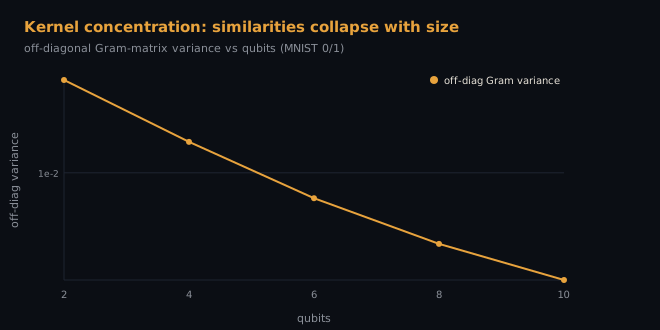
Everything starts to look the same, on-brand (generated): off-diagonal Gram-matrix variance collapsing 64× as qubits grow — the kernel analogue of the barren plateau.
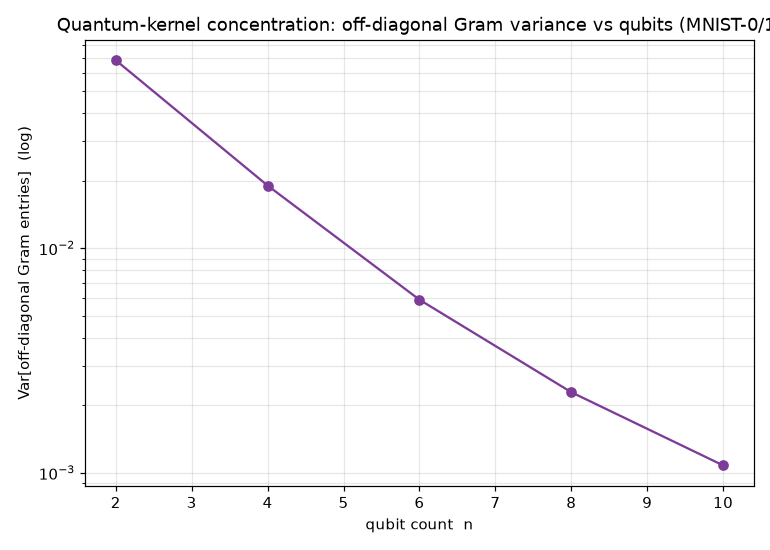
The matplotlib source figure: off-diagonal kernel-similarity spread shrinking with qubit count.
Honest caveats
The quantum kernel loses to the classical RBF-SVM on every dataset here — the spec-sanctioned honest outcome (§18D, D1/D2).
- No quantum-advantage claim: a negative result, reported plainly.
- The IQP fidelity kernel is one standard construction; concentration is a general property of expressive fidelity kernels.
- Off-diagonal Gram variance shrank 64× as qubits grew — scaling qubits makes it worse at separating points, not better.
Reproduce it
Accuracies trace to three_way.csv, concentration to concentration.csv (D7). experiments/20260710-095452_qk-qkernel.