Superconducting vs trapped-ion: I ran the same circuit on two quantum computers
· quantum, ibm-quantum, ionq, trapped-ion, hardware, error-mitigation, zne, honest-benchmarks
We took the exact same trained quantum circuit and ran it on two physically different quantum computers: IBM’s, which stores qubits in tiny superconducting loops chilled near absolute zero, and another built from single trapped ions — individual atoms held still by lasers. Same recipe, two utterly different machines. Then we compared each machine’s answer to the perfect simulator answer, and tried to clean up the noise on each — honestly reporting when the cleanup helped and when it backfired.
Same model, two machines
We never retrain per machine — that would burn hardware time for zero learning. We train once on the simulator, reconstruct the circuit natively, prove it matches the trained model to ~1e-15, then run inference on each backend. The superconducting run (ibm_fez) used 2048 shots; the trapped-ion run (ionq:forte-1) used 100. Both aim at the same exact simulator value, +0.7240.
The twist: better raw, worse mitigation
The headline you’d expect — ‘superconducting vs trapped-ion, who wins?’ — has an honest answer with a sting. The trapped-ion machine’s raw answer was closer to the truth. But zero-noise extrapolation, the same cheap trick that helped on the superconducting run, hurt here: at only 100 shots the noise-scaled points came out non-monotonic ([+0.60, +0.80, +0.52] at scales [1, 3, 5]), so the extrapolation ran the wrong way. That’s the whole lesson — mitigation is a tool with a failure mode, not a free ‘make it better’ button.
Results
| backend | technology | shots | sim ⟨Z₀⟩ | raw ⟨Z₀⟩ | mitigated ⟨Z₀⟩ | raw error | mit error |
|---|---|---|---|---|---|---|---|
| ibm_fez | superconducting | 2048 | +0.724 | +0.486 | +0.870 | 0.238 | 0.147 |
| ionq:forte-1 | trapped-ion | 100 | +0.724 | +0.600 | +0.320 | 0.124 | 0.404 |
Figures
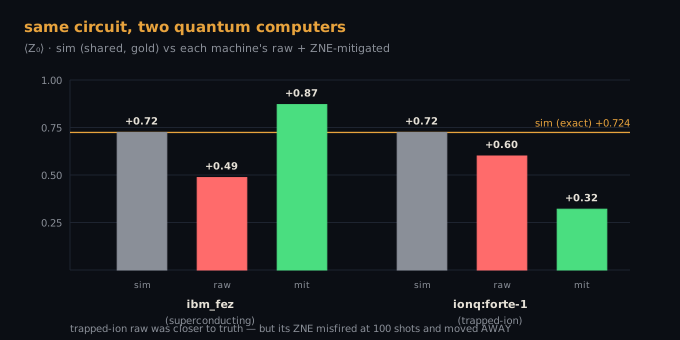
Same circuit, two machines (on-brand, generated): the shared simulator truth (gold line), then each backend’s raw (red) and ZNE-mitigated (green) ⟨Z₀⟩. The trapped-ion raw sits closest to the gold line — but its green mitigated bar overshoots past it, the misfire the numbers actually show.
Honest caveats
This is a cross-hardware reproduction of one trained model on two qubit technologies — not a quantum-advantage claim (D1). The honest finding has two halves, and the second is the interesting one:
- The higher-fidelity machine won the raw round. The trapped-ion raw ⟨Z₀⟩ (+0.600) landed only 0.124 from the simulator’s +0.724, closer than the superconducting raw (+0.486, off by 0.238) — even though it used far fewer shots (100 vs 2048).
- But its cheap mitigation backfired (§18E). Zero-noise extrapolation on the trapped-ion run moved the answer to +0.320 — now 0.404 from truth, further than the raw 0.124. At 100 shots the noise-scaled measurements at scales [1, 3, 5] came out non-monotonic ([+0.60, +0.80, +0.52]), so the extrapolation is dominated by shot noise and pulls the wrong way. Mitigation is not free and can hurt — we report it straight instead of hiding it.
- ZNE cost 3.0× the shots either way (§18E).
- On this toy 2-qubit task the classical baselines (Phase 1) match or beat the VQC (§18D); the value here is the honest sim-vs-hardware-vs-mitigated comparison across two technologies, not a win.
- Cost honesty (D4): the trapped-ion run billed 15 credits against a 20-credit cap — a real budget spent, reported.
Reproduce it
Every number traces to cross_hardware.json / summary.json / equivalence.json (D7). Open Quantum job id(s) 4f0ed05e-49f3-4ddb-ab75-03d00ec7998d, 5e453e57-fb83-4441-91af-5af8a3e654af, b2f1ed57-ef17-4a47-ab39-e67f7f36ba4d; IBM job id(s) d97qoc52su3c739if17g. experiments/20260711-090430_p3b-openquantum.