I watched a quantum model become untrainable — the barren plateau, measured
· quantum, qml, barren-plateau, trainability, vqa, honest-benchmarks
Training works by feeling which way is downhill (less wrong) and stepping that way. A barren plateau is when the landscape becomes a perfectly flat desert — every direction feels equally flat, so the circuit has no idea which way to step and training stalls. The nasty part: the desert gets exponentially flatter the bigger you build the circuit. We measured it on our own machine.
The measurement
Hardware-efficient ansatz (RY layers + CZ ring, depth ∝ width). We took the gradient variance Var[∂C/∂θ] over 200 random initialisations at each width, n = 2…14, for a global and a local cost observable. Global variance fell from 1.70e-01 to 1.18e-04 — a 1,436× collapse — fitting a clean exponential (α ≈ 0.638, r² = 0.990). The local observable decayed ~7.1× slower: the Cerezo-style shallow+local escape.
Results
| cost observable | decay rate α | log-linear fit r² | reading |
|---|---|---|---|
| global ⟨Z₀…Z_{n−1}⟩ | 0.638 | 0.990 | steep — a barren plateau |
| local ⟨Z₀Z₁⟩ | 0.089 | 0.913 | ~7.1× shallower — the escape |
Figures
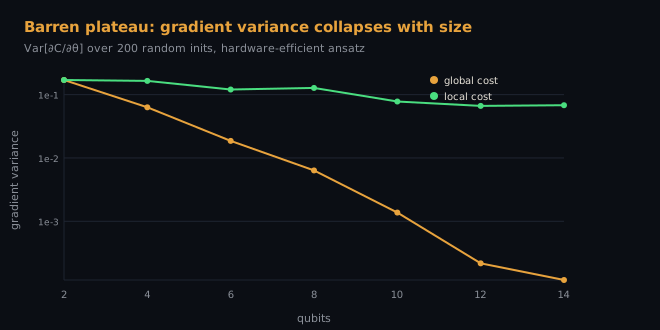
The flat desert, on-brand (generated): gradient variance vs qubits on a log axis. The global cost (gold) plunges 1,436× — a barren plateau; the local cost (green) barely moves — the escape.
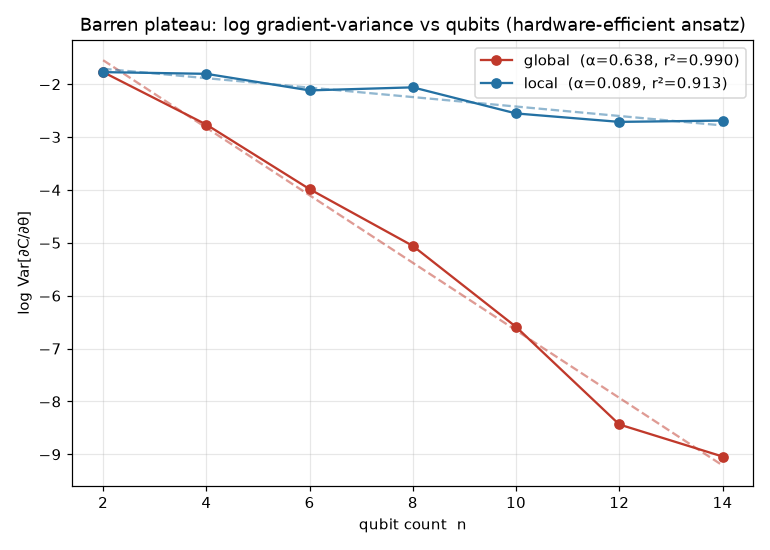
The matplotlib source figure: log gradient-variance falling as qubits grow (global collapses 1,436×; local stays shallow).
Honest caveats
This is a diagnostic sweep, not a training run: it measures where variational trainability fails, which is the deliverable (D1).
- The plateau is a real, quantitative negative result for global-cost hardware-efficient circuits; no quantum-advantage claim is made or implied.
- Parameter-shift gradients on a single scalar parameter — exact, seeded, reproducible.
- The deepest finding pairs with this: the trainable (shallow, plateau-free) regime is exactly the one a classical computer can cheaply copy. Trainable ⇒ not special; special ⇒ not trainable. That’s the honest 2025 dilemma, measured.
Reproduce it
Every variance traces to bp_metrics.csv, every fit to bp_fits.csv (D7). experiments/20260710-090941_bp-barren-plateau.