I ran a trained circuit on a real IBM quantum computer — here's the noise
· quantum, ibm-quantum, hardware, error-mitigation, zne, honest-benchmarks
Most of our work runs on a simulator — a normal computer pretending to be a quantum one. This time we sent one trained circuit to a real quantum computer at IBM (ibm_fez), over the internet, for free. Real hardware is noisy: the delicate qubits get bumped, so answers come out fuzzy. The question is how fuzzy, and how much of it we can clean up — honestly accounting for what the cleanup costs.
Three columns, one honest story
We never train on a real QPU (it burns free minutes for zero learning). We train on the simulator, then run inference on hardware. The native-Qiskit circuit provably matched the PennyLane model to ~1e-15 before it flew. Backend: ibm_fez, transpiled depth 63, 12 two-qubit gates.
Results
| measurement | ⟨Z₀⟩ (sample 0) | what it is |
|---|---|---|
| simulator (exact) | +0.724 | perfect, noise-free reference |
| raw hardware | +0.486 | real QPU, noise drags it toward 0 |
| ZNE-mitigated | +0.870 | error-mitigated, back near the clean value |
Figures
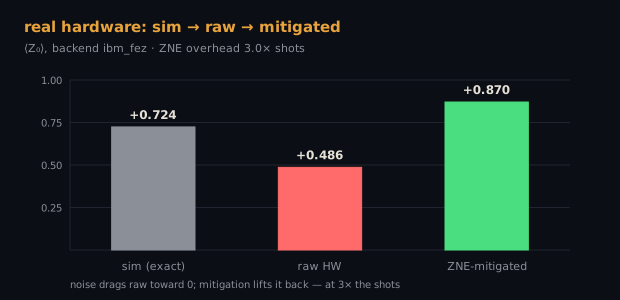
Noise, then cleanup (on-brand, generated): the simulator’s clean ⟨Z₀⟩, the real hardware’s noise-dragged value, and where zero-noise extrapolation pulls it back — bought with 3× the shots.
Honest caveats
This validates that a sim-trained model runs on real quantum silicon and that error mitigation lifts the raw signal — it is not a quantum-advantage claim (D1).
- Mitigation isn’t free: ZNE cost 3.0× the shots (§18E). We report the cost, not just the prettier point estimate.
- On this toy 2-qubit task the classical baselines match or beat the VQC; the value is the honest sim-vs-hardware-vs-mitigated comparison.
- The whole job used 5 s of QPU time against a hard 240 s budget cap with no override — so we can’t accidentally overspend (D4).
Reproduce it
Job id(s) d97qoc52su3c739if17g. Every number traces to summary.json / equivalence.json (D7). experiments/20260709-141149_p3-ibm-fez.