I let an LLM agent design quantum circuits in a sandbox for 10 cycles
· quantum, qml, agents, llm, sandbox, automation, honest-benchmarks
We handed the search over to an agent: an LLM reads the previous results, proposes a new circuit design, and runs it — but only inside a locked sandbox (no network, no writing outside its scratch folder, killed if it hangs). Ten cycles, no human in the loop, every decision written down. It structurally can’t reach real hardware — so it can never overspend the QPU budget.
The sandbox comes first
Untrusted, model-written code runs behind hard denials — proven before any of it executes. If any denial fails to fire, the whole loop aborts (fails closed):
| denial test | blocked? |
|---|---|
| network | ✅ yes |
| file-escape | ✅ yes |
| timeout | ✅ yes |
All denials held: True.
Ten autonomous cycles
The agent read prior results, proposed the next variant, ran it sandboxed, and scored it against the baseline on identical splits — writing its reasoning each time.
Results
| cycle | proposed variant | test acc | vs baseline |
|---|---|---|---|
| 0 | iqp/strongly_entangling L=8 | 0.9556 | -0.0222 |
| 1 | angle/basic_entangler L=12 | 0.4844 | -0.4933 |
| 2 | iqp/strongly_entangling L=6 | 0.8356 | -0.1422 |
| 3 | angle/strongly_entangling L=8 | 0.9733 | -0.0044 |
| 4 | angle/strongly_entangling L=10 | 0.9733 | -0.0044 |
| 5 | angle/strongly_entangling L=12 | 0.9822 | +0.0044 ✅ |
| 6 | angle/strongly_entangling L=16 | 0.9822 | +0.0044 ✅ |
| 7 | angle/strongly_entangling L=14 | 0.9822 | +0.0044 ✅ |
| 8 | angle/strongly_entangling L=18 | 0.9822 | +0.0044 ✅ |
| 9 | angle/strongly_entangling L=20 | 0.9689 | -0.0089 |
Figures
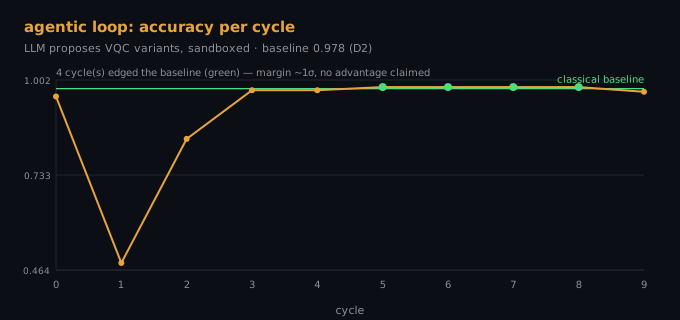
The agent’s search path (on-brand, generated): per-cycle accuracy against the fixed classical baseline (green). Green dots edged it; the dip at the end is the agent discovering that more depth started to hurt.
Honest caveats
The best cycle edged the baseline by +0.0044 (0.9822 vs 0.9778) — but the VQC’s own seed-to-seed noise is ~1σ of that, so this is consistent with a small statistical fluctuation on a near-saturated benchmark, not a quantum advantage (D1). The agent’s report says so itself.
- No quantum-advantage claim; the honest reading is a tie-ish improvement.
- Every proposed circuit ran sandboxed on the CPU simulator; the loop fails closed if a sandbox denial ever fails to trigger.
- The interesting result isn’t the number — it’s that an autonomous agent explored, found a collapse (a bad ansatz dropped to 0.48), abandoned it, and converged — with a written rationale per cycle.
Reproduce it
Every cycle traces to cycles.csv + per-cycle cycleNN_score.json; rationales in rationales.md (D7). experiments/20260710-114217_p5-agent.