How many qubits fit in 32 GB? I simulated until the GPU refused
· quantum, qml, gpu, benchmarking, cuquantum, mnist, honest-benchmarks
A hybrid model is a normal neural net with one quantum layer bolted into the middle: a classical encoder squeezes an image down, a quantum circuit processes it, a classical head reads out the answer. We taught it to tell a handwritten 0 from a 1. And we asked a second question the owner cared about: what actually happens when you throw the GPU at simulating a quantum computer?
The classical baseline wins (as expected)
MNIST 0/1 is nearly linearly separable, so logistic regression is already at the ceiling. The hybrid trains fine and lands a hair behind — exactly the spec-sanctioned outcome. We report the loss, side by side, and move on.
The GPU question
Max width that simulated on the GPU: 28 qubits. At 30 qubits the over-commit guard refused the run — the predicted statevector exceeds free VRAM (§18C, D6). A quiet twist worth stating: for the small circuits this project trains, the GPU is actually ~60× slower than the CPU statevector (kernel-launch overhead dominates); the card only earns its keep on the big-qubit simulations near the wall.
Results
| model | mean test acc | std | per-seed |
|---|---|---|---|
| hybrid (quantum layer) | 0.9954 | 0.0012 | 0.9962, 0.9962, 0.9937 |
| logistic regression | 0.9962 | — | 0.9962, 0.9962, 0.9962 |
| MLP (16,16) | 0.9954 | — | 0.9962, 0.9950, 0.9950 |
Figures
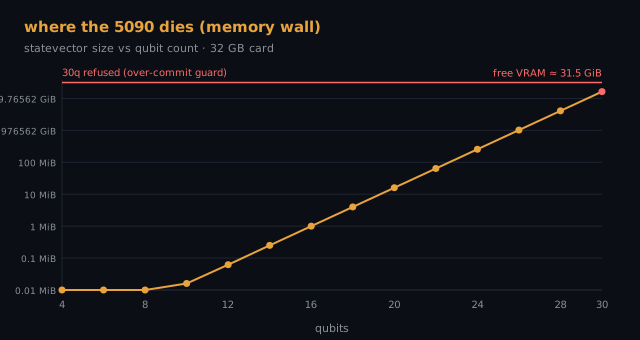
Where the 5090 dies (on-brand, generated): the statevector doubles every qubit, so VRAM climbs a straight line on the log axis until the 30-qubit run is refused past the 32 GB ceiling (red).
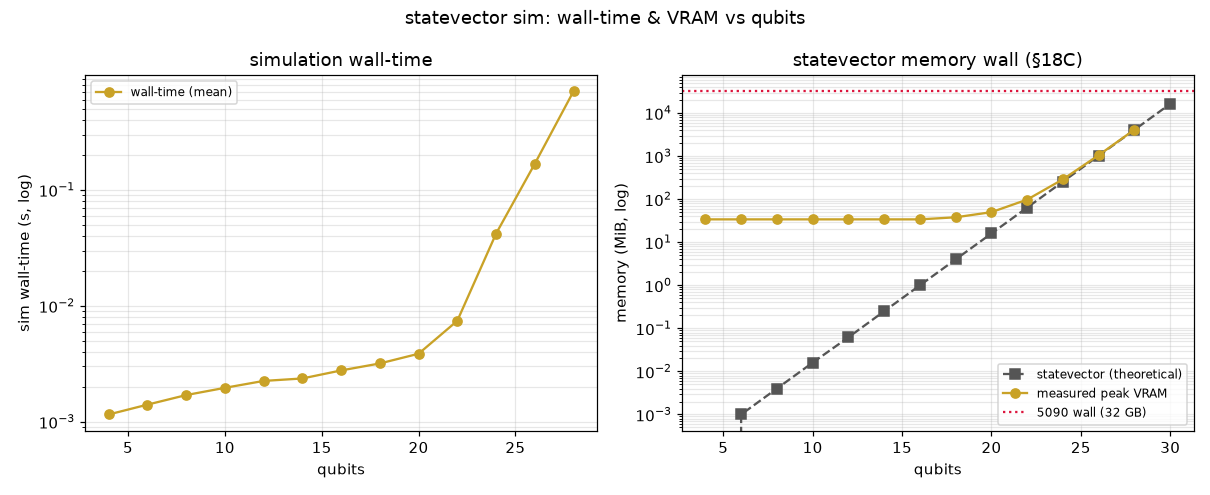
The measured benchmark: simulation wall-time and peak VRAM climbing with qubit count.
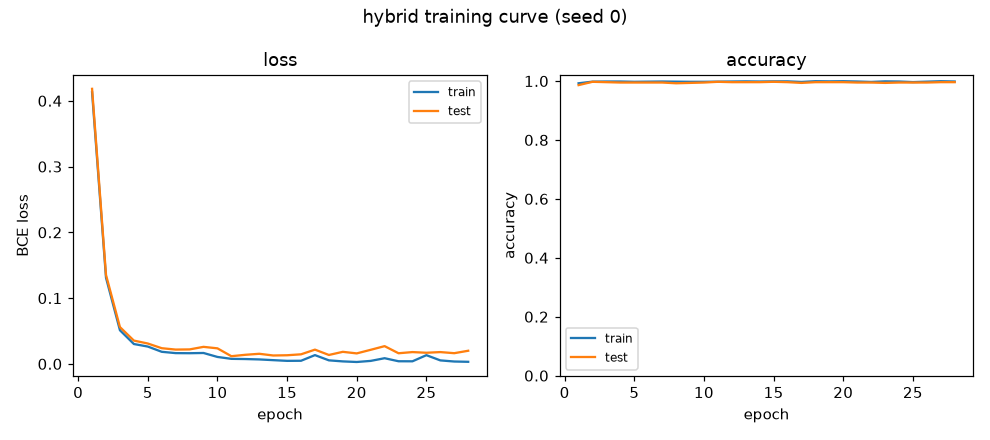
The hybrid model’s training curve on MNIST 0/1.
Honest caveats
The hybrid (0.9954) loses to the best classical baseline (0.9962) — the expected, spec-sanctioned outcome (§18D). Logistic regression on MNIST 0/1 is ~99.9%; a hybrid a hair behind is the honest, publishable finding. Reporting the loss is the deliverable.
- Claiming quantum advantage is permanently out of scope (D1).
- The classical baseline is the credibility engine (D2).
- The memory wall is honest content: it shows exactly where a 32 GB card can no longer hold the statevector (§18C).
Reproduce it
Every accuracy traces to seed_summary.csv; every VRAM/time point to benchmark.csv (D7). experiments/20260709-123142_mnist01-hybrid.